
Office Clearance Brockley — Health & Safety Policy
This document defines the health and safety policy for our office clearance and rubbish removal operations. It sets out the commitment to protect employees, clients, contractors and the public during all stages of office clearance, commercial clearance and related waste removal services. The policy emphasises safe working methods, risk reduction, and ongoing monitoring to ensure a reliable and compliant service.
Policy objectives and scope
The primary objectives are to prevent harm, reduce hazards and provide a safe environment for office clearance crews and customers. This policy covers general office clear-outs, bulky waste collection, electronic waste handling and routine rubbish removal tasks. Responsibilities apply to all staff, temporary personnel and subcontractors engaged in our business activities.

Responsibilities and leadership
Senior management accepts ultimate responsibility for implementing this policy and will ensure resources are available for training, equipment and supervision. Line managers and team leaders must enforce safe working practices, conduct briefings and support a culture where safety concerns can be raised without fear. Employees are expected to follow procedures, wear required protective equipment and report hazards.
Risk assessment and planning
Risk assessments will be carried out prior to every job to identify specific hazards such as trip risks, manual handling, sharp objects, electrical items and potential hazardous materials. Assessments will determine control measures like segregation of waste streams, safe lifting techniques and staged clearance plans for larger commercial clearances. Records of assessments are maintained for review.
- Pre-site inspection: establish access, parking and any site-specific risks.
- Hazard identification: note items requiring specialist disposal (e.g. batteries, electronic equipment).
- Control measures: assign PPE, tools and personnel based on assessed risk.

Training, competence and PPE
All staff receive training in manual handling, safe use of equipment, waste segregation and basic first aid. Training is refreshed periodically and whenever new equipment or processes are introduced. Staff must wear appropriate personal protective equipment such as gloves, high-visibility clothing, safety footwear and eye protection when required. The company will provide suitable PPE and ensure its proper maintenance.
Manual handling and ergonomics
Manual handling procedures focus on reducing physical strain and avoiding injury. Team lifts, mechanical aids and trolleys are used for heavy or bulky items. Workers are trained to assess items for weight, stability and sharp edges prior to lifting. Proper posture and lifting techniques must be observed at all times to protect back health and overall wellbeing.
Vehicle operations and site safety
Transport of cleared materials must be carried out in secure, roadworthy vehicles operated by licensed drivers. Loading and unloading procedures minimise the risk of falling objects and ensure loads are correctly restrained. Parking and vehicle access plans consider pedestrian safety outside client premises during rubbish collection operations.
Waste segregation and disposal
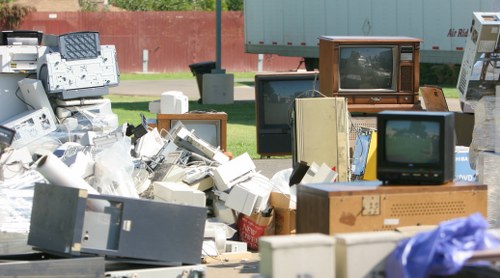
Waste streams are separated at source into recyclable materials, general waste and hazardous items requiring specialist handling. Electronic waste and batteries are removed and processed according to recognised disposal routes. Where suspected hazardous materials are encountered, work will stop and the item isolated for specialist assessment. The policy promotes reuse and recycling wherever practical to reduce landfill dependency.
Incident reporting, first aid and emergency response
All incidents, injuries and near misses must be reported immediately. An accident reporting procedure ensures timely investigation, corrective actions and record-keeping. First aid kits and trained first-aiders are available on-site during operations. Emergency procedures are communicated during job briefings and include steps for fire, medical emergency or major spill response.

Contractor management and supervision
Subcontractors engaged for specialised tasks will be assessed for competence, insurance and safety performance. Contracts include clear safety obligations and expectations for rubbish company service activities. Supervision ensures that standards are consistently applied and that any deviations are corrected promptly.
Monitoring, review and continuous improvement
Performance is monitored through routine inspections, safety audits and reviews of incident data. The policy is reviewed regularly to respond to operational changes, new risks and emerging best practices in the clearance and waste removal industry. Continuous improvement underpins our approach to health and safety, and staff input is encouraged to refine procedures.
Closing statement
This health and safety policy represents a commitment to safe, sustainable and professional office clearance services. It applies across all clearance operations and supports the delivery of efficient rubbish removal and commercial clearance work while safeguarding people and property. Compliance is mandatory for everyone involved and forms an integral part of the company’s operational standards.
